 |
|
 |
|
| What many scholars fail to recognize is the enantiomorphic
nature of symbols; i.e., that every symbol contains its opposite (Atomic
Bomb Cinema, 119).
|
|||
|
|
|||
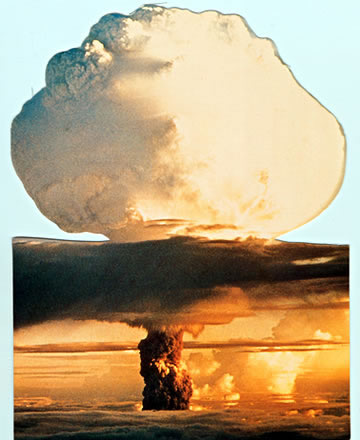
Front of card
Back of card
|
|||
| Many Bomb films are uproariously funny. Atomic Bomb Cinema is enriched by what may be broadly called Jewish humor. In a 1941 Nazi camp, Rabbi Erich Weiner observed that Jews' subversive humor "strengthened their will to survive as well as infused their power to resist." Jewish humor, in other words, is filled with the spirit of Tikkun Olam. The will to resist and to survive is, ultimately, the will to repair and restore one's world (Atomic Bomb Cinema, 31). Most scholars would say that consumers of nuclear imagery are "psychically numb," the victims of "nuclearism." Possibly. It could also be that consumer items, like this greeting card, are alluring precisely because of that dynamic engendered by the enantiomorphic nature of the bomb as a symbol: One both terrifying and beautiful. Using the nuclear image in this way is also funny, in that, in a sense, it subverts the oppressive nature of the bomb. |
|||
 |
© 2001 ATOMIC BOMB CINEMA LTD. | |